Category: Electric Vehicles
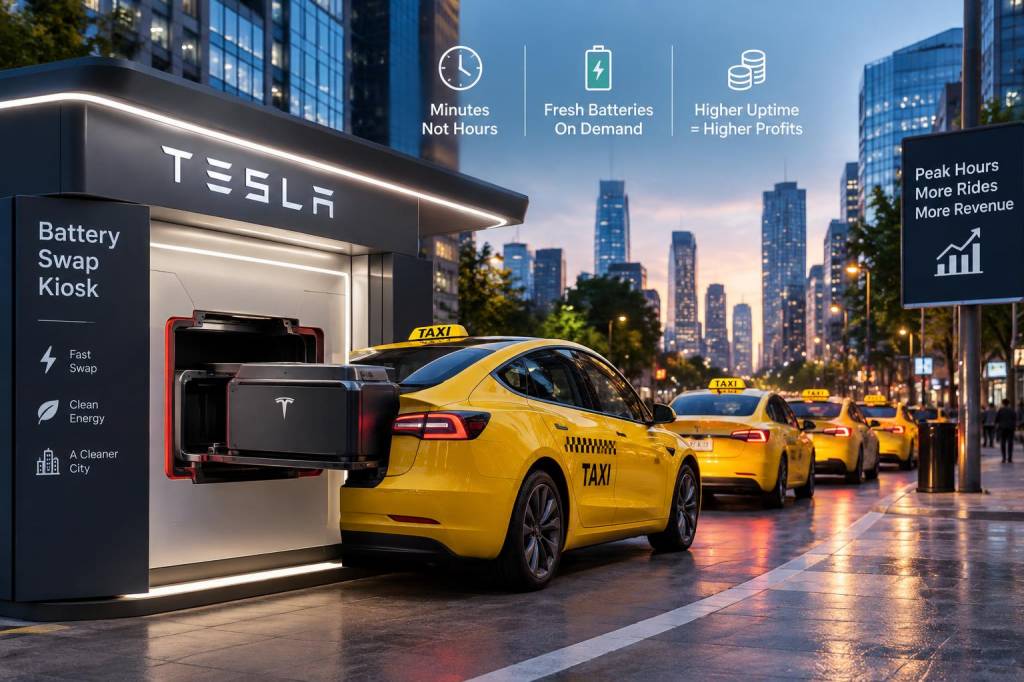
I remember the first time I read about battery swapping for electric vehicles — it sounded like a clever workaround to range anxiety and long charging times. Today, Tesla's on-street battery swap kiosk concept feels like a potential game-changer for urban taxi fleets, especially during those frantic peak hours when every minute of vehicle uptime translates directly into revenue. But can these kiosks realistically make taxi operations profitable during rush periods? From my perspective, the answer hinges on a mix of operational efficiency, infrastructure design, cost structure, and how well the solution integrates into existing fleet management systems.
What problem are on-street battery swap kiosks trying to solve?
The core problem is simple: taxis need to be on the road during high-demand periods. Traditional plug-in charging takes time — even with fast chargers, 15–30 minutes can be lost per vehicle. For a taxi driver, that's lost fares. Battery swapping aims to reduce downtime to a few minutes by replacing a depleted pack with a charged one. On-street kiosks bring this capability directly into urban environments, reducing travel to depots and enabling more continuous service during peaks.
How do these kiosks work in practice?
Based on prototypes and other swap systems (like NIO in China or Gogoro for scooters), an on-street swap kiosk would:
For taxi fleets, the ideal scenario is a near-seamless interaction: a driver pulls up, swaps the pack while completing a fare or doing a quick bathroom break, and heads back out with minimal interruption.
Will swap kiosks actually make taxi fleets more profitable during peak hours?
Profitability depends on several levers. Here are the ones I think matter most:
Put these together: if swaps are quick, kiosks are near peak demand, and the cost per swap is competitive, fleets can increase the number of peak-hour trips per vehicle enough to outweigh the kiosk-related costs. In other words, profitability is plausible but not automatic.
What are the key operational challenges?
From my discussions with fleet operators and urban planners, several challenges keep cropping up:
How does this compare to other fast-refueling approaches?
There are three main alternatives for keeping taxis moving during peaks:
On-street swap kiosks sit between ultra-fast chargers and depots: they aim to combine speed with geographic flexibility. For taxi fleets in dense city cores, that mix could be especially compelling.
What about costs — both capex and opex?
To evaluate profitability, you need to understand the economics. Below is a simplified table illustrating hypothetical per-swap costs and potential revenue upside for a single taxi during a peak window.
| Metric | Assumption | Value |
|---|---|---|
| Swap time saved vs fast charge | Minutes | 20 minutes |
| Additional trips per saved hour | Trips/hour | 1.0 |
| Average fare per trip (peak) | GBP | £12 |
| Revenue gain per swap | Estimated | £4 (pro-rated) |
| Per-swap operational cost | Energy + maintenance | £1.50 |
| Net gain per swap | Estimated | £2.50 |
These numbers are illustrative. Real fleets will see different values based on local fares, energy prices, kiosk amortization, and driver behavior. The crucial point is that even modest per-swap gains, multiplied across many swaps and many vehicles during sustained peaks, can add up.
What about the driver and passenger experience?
From conversations with drivers, the swap has to be frictionless. Drivers care most about uptime and income per hour. If swaps are fast and reliably located, drivers will adapt their routines. For passengers, any option that reduces wait times and improves availability is positive. Some riders might be curious or wary of robotic kiosks on the pavement; clear signage and visible safety measures help build trust.
Which cities or fleet types stand to benefit most?
High-density urban cores with strong peak congestion — think London, New York, Paris, Tokyo — are obvious candidates. Fleets that operate short, frequent trips (airport shuttles, dispatch taxis, rideshare fleets in central business districts) will see the most value because their vehicles repeatedly return to the urban core and can exploit kiosks multiple times per shift.
Real-world precedents and technological readiness
We can learn from NIO's battery swap stations for passenger cars and Gogoro's scooter swap network. Both show that the model can scale when a critical mass of vehicles and users exists. For Tesla specifically, the proprietary battery architecture poses a deployment question: will Tesla open a swap standard to the broader industry or keep it within their ecosystem? The former multiplies benefits; the latter limits impact to Tesla-based fleets.
From a technology standpoint, automated robotic swapping, secure battery locking mechanisms, and remote diagnostics are mature enough to prototype kiosks today. The harder parts are urban permitting, commercial agreements with cities, and aligning incentives for fleet operators and kiosk providers.
What should fleet managers and city planners be asking?
Here are some practical questions to surface in planning sessions:
Answering these will determine whether kiosks are a clever pilot or a citywide profit driver.
Ultimately, I believe on-street battery swap kiosks could make urban taxi fleets more profitable during peak hours — but only if implemented thoughtfully. The potential is clear: faster turnarounds, higher vehicle utilization, and better service levels. The real test will be pilots that demonstrate reliable operations, affordable economics, and minimal urban friction. I’ll be watching any Tesla pilots closely, and sharing updates as experiments move from concept to curbside reality on Mobility News.