I’ve been thinking a lot lately about what it would take for electric taxis — particularly Tesla fleets — to truly operate like their petrol counterparts: running all day without long downtime for refueling. One idea that keeps coming back is modular battery swap kiosks. Could they realistically let Tesla taxis stay on the road all day? From my perspective working at the intersection of mobility and urban tech, the idea is tantalising, but it raises as many questions as it answers.
Why battery swapping feels so attractive
When you watch a petrol car pull into a station, refuel in a few minutes and be back on the road, the convenience is obvious. For high-utilisation vehicles like taxis and rideshare, downtime is directly tied to revenue. That’s why the notion of swapping a depleted battery for a fully charged one in minutes is so compelling for operators.
I think the primary appeal is operational continuity. A modular swap kiosk concept promises:
- Minimal downtime: swaps could be under five minutes versus 30–60 minutes for many public fast chargers.
- Centralised battery management: operators can control charging schedules, battery lifecycle, and thermal management off-vehicle.
- Reduced vehicle weight variance: if standardised packs are used, vehicle handling can be more predictable across a fleet.
Why Tesla taxis are a special case
Tesla has built a vertically integrated product with a unique battery architecture, proprietary battery packs and a sprawling Supercharger network. That combination raises three core points I always consider:
- Proprietary design: Tesla batteries are not easily removable or modular in the way early swap concepts (like Better Place) envisioned.
- Software control: Tesla tightly manages vehicle software and battery health remotely; any swap ecosystem would need deep integration.
- Existing infrastructure: Tesla’s Supercharger network is robust and expanding, but it still costs time for top-ups during high utilisation.
How a modular swap kiosk could work in practice
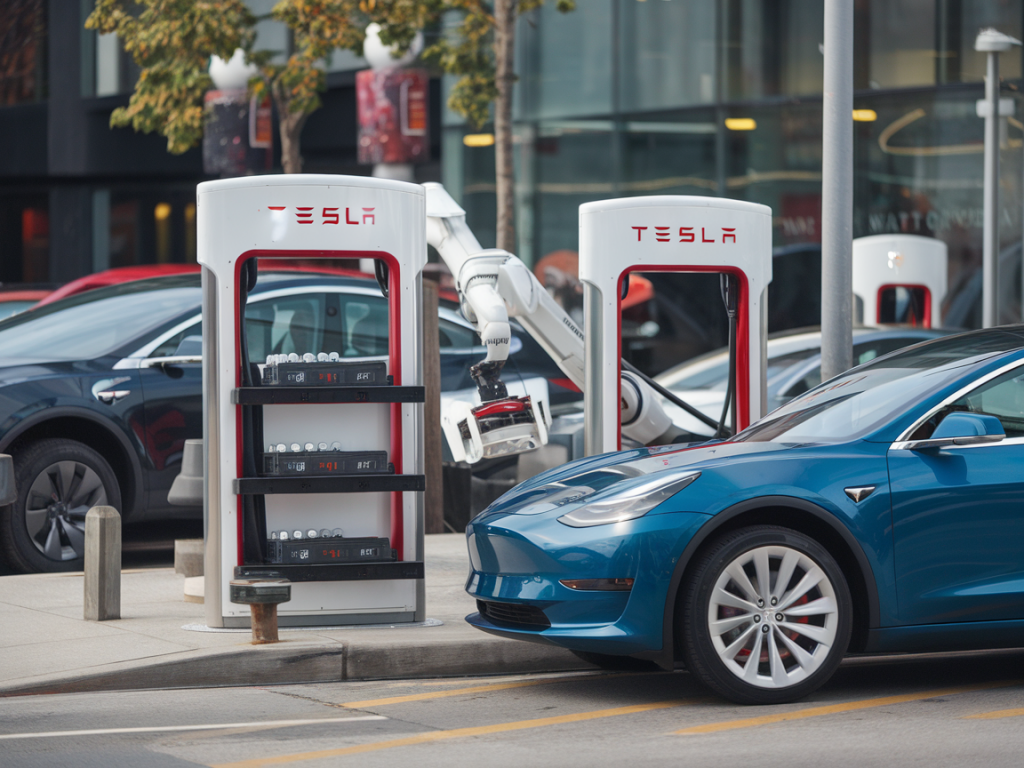
Imagining a real-world kiosk, I picture a compact automated station with several key features:
- Standardised removable battery modules designed for automated handling.
- Robotic swap mechanism that extracts and inserts modules without human intervention.
- On-site thermal management and charging racks that recharge swapped modules on a schedule.
- Cloud integration that authenticates vehicles, manages billing, and tracks battery health.
If Tesla vehicles were to adopt modular packs (or if third parties offered retrofittable modular solutions), this could enable taxi operators to schedule quick swaps at hubs during short breaks between rides — keeping cars productive for longer parts of the day.
Practical challenges and questions people always ask
When I talk about this with fleet managers and urban planners, the same questions come up repeatedly. I’ll tackle the main ones here.
Would swapping reduce battery lifespan?
Battery cycling and thermal stress determine lifespan. If the swap network treats cells well — controlled charging, temperature management, and balanced cycling — swapped packs could be healthier than chaotic fast-charging regimes. But it requires tight operational discipline and continuous monitoring.
How would Tesla react to third-party swap kiosks?
Tesla’s business model is built on vertical control, and they historically resisted third-party hardware interfacing with vehicles. Only if Tesla sees commercial value for taxis — or decides to deploy its own swap solution — would integration be simple. Otherwise, retrofitting would need non-invasive standards and likely legal/regulatory workarounds.
Are safety and standardisation solvable?
Standardisation is the linchpin. Past initiatives like Better Place failed partly because automakers didn’t adopt a single standard. For taxis, a coalition of OEMs or a regulated standard for commercial fleets could change that. Safety is addressable through redundant locking mechanisms, sensors, and certified battery enclosures, but it increases kiosk cost and complexity.
Economic considerations
From a fleet operator’s perspective, it boils down to total cost of ownership (TCO). A modular swap system introduces capital expenditure for kiosks and spare battery inventory, but it can reduce downtime and potentially extend vehicle utilisation. Key economic levers include:
- Cost per swap vs cost per kWh at fast chargers.
- Depreciation and lifecycle management of modular packs.
- Space costs for kiosk siting in dense urban areas.
- Billing models: subscription vs pay-per-swap.
| Factor | Swap kiosk | Fast charging |
|---|---|---|
| Downtime per event | ~3–10 minutes | 15–60 minutes |
| CapEx requirements | High (kiosks + spare packs) | Moderate (chargers + power upgrades) |
| Battery lifecycle control | High (centralised) | Lower (in-vehicle stress) |
Operational and urban integration questions I worry about
Implementing swap kiosks at scale in a city is not just about technology. I think about traffic flow, land use and regulation. Where do you site kiosks? Near taxi stands, depots, or at high-demand hubs? Kiosk footprint and queuing management will matter. Cities may favour centrally managed hubs to avoid curbside congestion.
There’s also grid impact. Large fleets swapping batteries will shift energy demand patterns; if swaps coincide with peak grid hours, you risk stressing distribution networks unless kiosks include managed charging, onsite storage, or demand-response integration.
What we can learn from past and current experiments
Better Place’s failure in the early 2010s is an important lesson — technology alone doesn’t win. It requires OEM buy-in, business model alignment, and the right timing. More recently, Nio’s battery swap network in China has shown the model can work when backed by a single manufacturer with strong fleet demand. I pay attention to Nio because they prove swaps can be fast, reliable and even profitable within the right ecosystem.
For Tesla taxis specifically, I imagine two possible pathways:
- Tesla-led solution: Tesla designs modular packs and deploys proprietary swap kiosks for fleet clients.
- Third-party retrofit network: Independent players build modular packs and kiosks with compatibility layers, convincing fleets and regulators to adopt them.
Final thoughts as someone who obsesses over mobility systems
I’m excited by the potential. Modular battery swaps could transform fleet operations and unlock near-continuous availability for taxis. But the path is not purely technical — it’s political, economic and logistical. For Tesla taxis to stay on the road all day via swaps, we’d need standardisation, OEM cooperation (or clever retrofits), solid urban planning for kiosk placement, and a business model that makes sense for operators and cities alike.