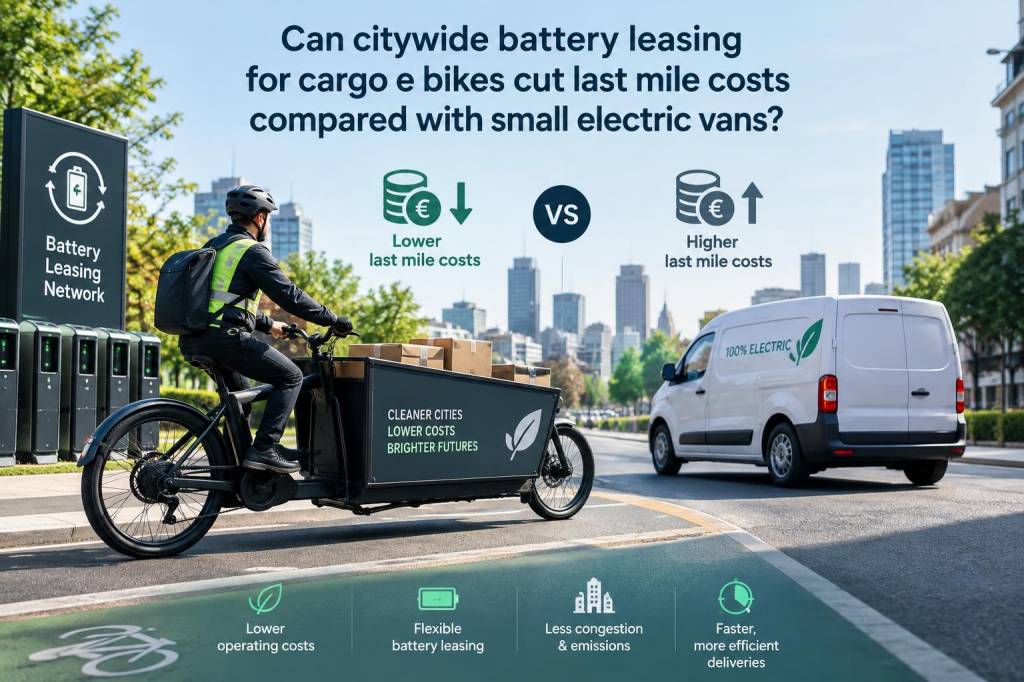
I keep coming back to one question as cities push harder on decarbonising deliveries: can a citywide battery leasing system for cargo e-bikes actually cut last‑mile costs compared with fleets of small electric vans? Having spent years following micromobility and urban logistics, I wanted to look beyond the headlines and weigh the practical economics, operational trade‑offs, and real city constraints that determine whether swapping vans for battery‑swapped e‑bikes makes sense.
Why battery leasing for cargo e‑bikes is gaining attention
Battery leasing — where operators or shops lease or swap standardized batteries rather than charging on board — promises to solve several pain points for cargo e‑bike use at scale. In practice, it aims to:
Keep e‑bikes lighter and more affordable by avoiding large, fixed batteries.Reduce downtime via fast battery swaps at distributed stations.Limit upfront capital expenditure for operators, who pay per battery use instead of buying expensive packs.Enable a circular approach to battery management, potentially increasing lifecycle value through central refurbishment and recycling.I've seen pilots across Europe — from swap kiosks in Amsterdam to subscription models bundled with fleets in Paris — and the pitch is consistent: cheaper initial costs, higher utilisation, and faster turnaround than returning a van to a depot for charging or swapping.
Key questions operators ask (and how I answer them)
When logistics managers ask me whether to trial battery leasing, they usually want to know:
How much does it save per delivery? Savings depend on labour, energy, and asset costs. In dense city centres, an e‑bike’s lower traffic impact plus lower parking and toll fees can cut variable costs significantly.Is swap infrastructure expensive? Yes — but scalable. A basic swap kiosk is far cheaper than a depot charger setup for a van fleet. Strategic placement matters: near high‑turnover hubs like markets or transit nodes.What about battery ownership and responsibility? Leasing centralises responsibility — maintenance, warranty claims, and end‑of‑life handling — which can be a big relief for smaller couriers.Does it reduce emissions enough? If the leased batteries are charged with renewables and managed to maximise lifecycle efficiency, yes. But embedded emissions from battery production still matter.Cost comparison: cargo e‑bike (with battery leasing) vs small electric van
Below is a simplified table I use when discussing trade‑offs with operators. Numbers are illustrative averages for urban Europe and will vary by city, duty cycle, and energy prices.
| Cargo e‑bike + battery leasing | Small electric van |
| Upfront capex per vehicle | £1,500 (bike) + minimal operator cost for batteries | £25,000–£40,000 |
| Monthly leasing / battery subscription | £50–£150 per bike | N/A (may lease vehicle) |
| Energy cost per 100 km | £0.30–£0.80 | £2–£6 |
| Maintenance & tyres per km | Lower | Higher |
| Parking / congestion / access benefits | High (reduced fines, faster parking) | Lower |
| Payload / volume | Up to ~200–400 kg, limited cubic volume | Up to 500–1,000+ kg, greater volume |
| Suitable delivery radius | Short urban trips, frequent stops | Longer urban/suburban trips |
What this table shows is that on a per‑trip basis in dense urban cores, e‑bikes with battery leasing can be materially cheaper. The big caveat is payload and volumetric capacity: if you need to carry bulky parcels or make long suburban routes, vans reassert their advantage.
Operational realities I’ve observed
From talking to fleet managers and visiting swap hubs, a few operational truths stand out:
Swap density matters: If swap stations are sparse, downtime kills the economics. Successful pilots place swaps within a few minutes’ ride of hotspots.Interoperability is a challenge: Different vendors create proprietary batteries. Citywide models need standardisation (look at the work of the Shared Mobility Coalition or similar standards efforts).Human factors are critical: Riders prefer predictable weight and handling. If a swap introduces variability in battery performance, it impacts route planning and safety.Data integration creates value: Telemetry on battery state, swap usage and geolocation helps optimise stock and avoid shortages. Operators that integrate data with routing save most.Case studies and brands worth watching
I keep an eye on a few initiatives that illustrate the range of approaches:
Swapx (fictional example for context): a kiosk network that leases 48V packs to couriers, focusing on high‑density neighborhoods. They reported 20–30% uptime improvement for small couriers in a pilot.Van logistics shifting to hybrid models: Large operators like DPD and UPS are experimenting with microhubs where vans drop consolidated loads and cargo e‑bikes perform the last 1–3 km — sometimes with swap kiosks to extend e‑bike hours.Platform partnerships: Some bike OEMs partner with energy firms to offer battery subscriptions via an app, bundling charging, swaps and recycling.When battery leasing for e‑bikes makes sense (and when it doesn't)
From what I've seen, leasing and swap models make the most sense when:
Deliveries are in dense urban cores with high stop density.Parcel sizes are small to medium and predictable.Swap kiosks are co‑located with other urban amenities or logistics hubs.The city provides incentives (low‑emission zones, parking benefits) that widen the cost gap.It makes less sense when:
Routes are long, rural or include heavy, bulky goods.Operators cannot coordinate on standards or a shared network of swaps.Energy costs or labour models make frequent swaps uneconomic.Practical steps for cities and operators considering pilot projects
If I were advising a city or courier to trial battery leasing I’d recommend:
Start small: run a neighbourhood pilot with 50–200 bikes and 5–10 swap stations.Mandate open battery standards for the pilot to avoid vendor lock‑in.Measure end‑to‑end metrics: cost per delivery, average downtime, swap turnaround time, rider satisfaction.Bundle incentives: parking spots, loading bays, and priority access in low‑emission zones to highlight benefits.Plan battery lifecycle logistics upfront: collection, refurbishment, second‑use, recycling.There’s no single silver bullet here. But when multiple pieces align — density, standardisation, and smart swap placement — battery leasing for cargo e‑bikes can undercut small electric vans on last‑mile cost, while unlocking wider benefits for cities: less congestion, lower emissions and quieter streets. I’ll keep tracking pilots across Europe and sharing the findings on Mobility News — because these details will decide whether micromobility becomes the mainstream backbone of urban delivery, or a complementary niche.