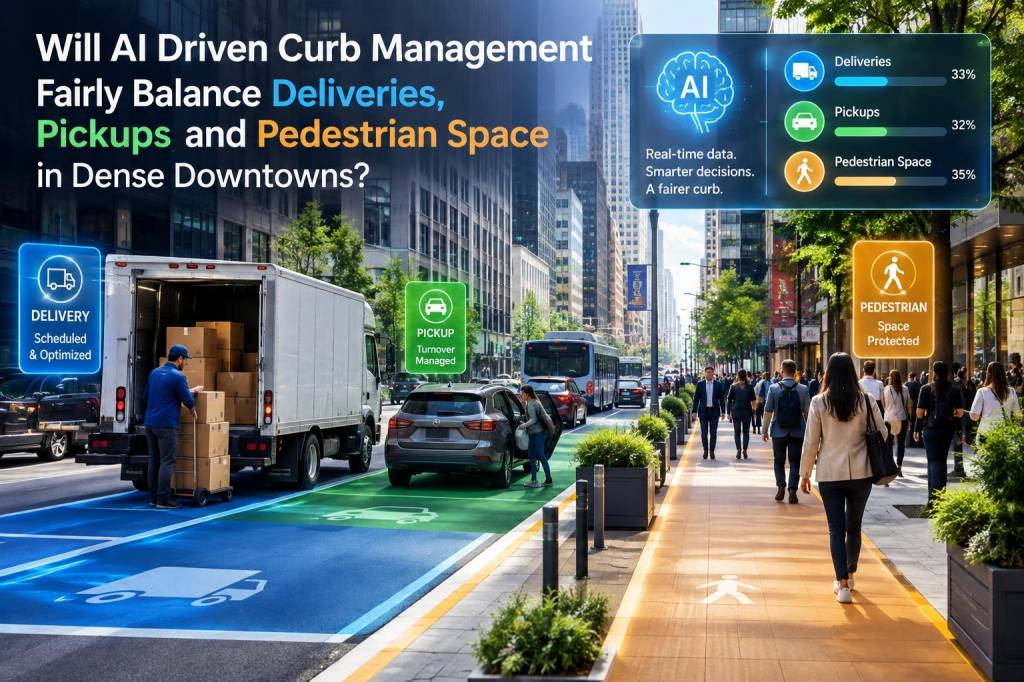
I watch downtown streets the way some people watch the weather: patterns, shifts, sudden surprises. Deliveries double-parked at rush hour, ride-hail vehicles circling for a fare, cyclists carving between curbside pickup zones and bus stops, and pedestrians squeezed onto narrow sidewalks. As cities densify, the curb — that thin strip between private vehicle lanes and the public sidewalk — has become one of the most contested pieces of urban real estate. Lately, people keep asking me: can AI-driven curb management really balance deliveries, pickups and pedestrian space fairly in dense downtowns?
What do we mean by "AI-driven curb management"?
When I talk about AI-driven curb management, I mean systems that use data, machine learning and real-time optimization to allocate curb use dynamically. These systems ingest feeds from sensors, cameras, GPS traces, parking apps, delivery platforms and municipal schedules, and then make decisions about which curb segments should be dedicated to loading, short-term parking, micromobility docks, bus stops or pedestrian plazas at different times of day.
Companies like Coord, Remix (now part of Via), and startups piloting curb-control software are already integrating with city operations. Tech giants such as Google Maps and HERE are layering curb features into routing. The AI bit comes in when the system must predict demand, resolve conflicting uses, price dynamically, and adapt to disruptions — for example, a concert, a road closure, or a sudden spike in deliveries due to a sale.
Why the curb matters more than people think
I've written and thought a lot about streetscape design and mobility policy, and one thing is clear: the curb is not just for cars. It's where goods enter the city, where people step into the public realm, and increasingly where private operators provide services. How we manage it affects traffic flow, commercial activity, accessibility for people with disabilities, safety for pedestrians and cyclists, and the viability of sustainable transport modes.
Can AI really be fair?
Fairness is the crux of the debate. AI can bring efficiency, but efficiency does not automatically equal fairness.
Here are common questions I hear — and how I think AI can address them (and where it risks failing):
What trade-offs must cities accept?
When I imagine a downtown with perfect AI-managed curbs, I also imagine trade-offs. Cities must decide what matters: economic activity, traffic throughput, pedestrian experience, inclusive access, or emissions reduction. AI can juggle these values but cannot invent them.
- Time-based trade-offs: Curb that serves deliveries at 8–10am might become a pedestrian plaza from 11am–3pm. AI can automate this time-sharing, but businesses used to fixed allocations might resist.
- Pricing trade-offs: Dynamic pricing can disincentivize long-term occupation, but variable fees can unfairly burden small businesses unless exemptions and caps exist.
- Enforcement trade-offs: Automated enforcement (camera-based fines) increases compliance but raises civil liberties concerns and must be balanced with clear signage and appeals processes.
Examples and pilots that tell us something
I've followed pilots in cities like San Francisco, London and Barcelona. San Francisco's SFpark showed that variable pricing could reduce cruising for parking. Barcelona’s superblocks reallocated street space to pedestrians, albeit through policy rather than AI. Newer projects combine both: curb-management trials that use data to shift allocations hourly and price dynamically during peak delivery windows.
These pilots reveal a recurring pattern: technology amplifies the values of its implementers. Where local government leads with equity-focused goals, systems tend to protect pedestrian priorities. Where private operators drive deployment, systems may favor commercial throughput. That’s why governance matters.
How to build AI systems that aim for fairness
From my vantage point, successful systems combine technological rigor with civic oversight. Here are the elements I believe are essential:
- Multi-objective optimization: Algorithms should balance throughput, pedestrian safety, accessibility, emissions and economic vitality explicitly, not as afterthoughts.
- Data diversity: Use multimodal inputs — pedestrian counts, deliveries, transit schedules, bike flows — to avoid blind spots. Relying solely on vehicle GPS will bias decisions.
- Transparency and auditability: Publish decision rules, performance metrics and historical allocation data. Allow third-party audits and community review.
- Adaptive pricing with protections: If using dynamic pricing, include small-business exemptions, caps, or credits to prevent disproportionate impacts.
- Human-in-the-loop: Keep city planners and community stakeholders in the loop. AI should recommend; humans should ratify strategic priorities.
What about enforcement, privacy and equity?
These are the friction points that often derail otherwise promising systems. Automated enforcement via cameras can improve curb turnover but raises privacy concerns. Computer vision can identify vehicles but must be designed to avoid facial recognition or other invasive profiling. Equity demands that low-income neighborhoods receive the same level of intelligent management and that dynamic pricing doesn’t become a regressive tax on small merchants.
| Concern | Risk | Mitigation |
|---|---|---|
| Privacy | Surveillance creep, data misuse | Edge processing, anonymization, strict retention policies |
| Equity | Disproportionate financial burden | Exemptions, caps, revenue recycling to local businesses |
| Transparency | Opaque decisions undermine trust | Open dashboards, public APIs, explainable models |
| Enforcement | Overzealous fines, legal challenges | Clear signage, appeals, phased enforcement |
How will street life change if we get this right?
Imagine a downtown where morning delivery bays open up from 6–10am, curbside transit boarding ramps expand during commute hours, restaurants have pop-up loading zones mid-day, and pedestrian plazas bloom in the afternoon — all coordinated by an orchestration layer that responds to real-time data. That’s the optimistic vision. It's not just efficiency; it's about enabling street life that's safer, economically vibrant and more sustainable.
What should cities do now?
My recommendation for city leaders is pragmatic: start small, define values, and iterate. Pilot AI-driven curb programs in limited corridors, measure impacts across equity and mobility metrics, and scale only when transparent governance is in place. Engage local businesses, paratransit users, pedestrians and delivery platforms early, because buy-in matters.
In the end, AI is a tool, not a silver bullet. It can help mediate conflicts over scarce curb space, but it will only fairly balance competing needs if we design systems with fairness baked into their objectives, enforce protections for vulnerable groups, and insist on transparency. As I keep watching those curbside patterns, I remain cautiously hopeful — technology can help rewrite the rules of the curb, but the values we encode into it will determine who benefits.