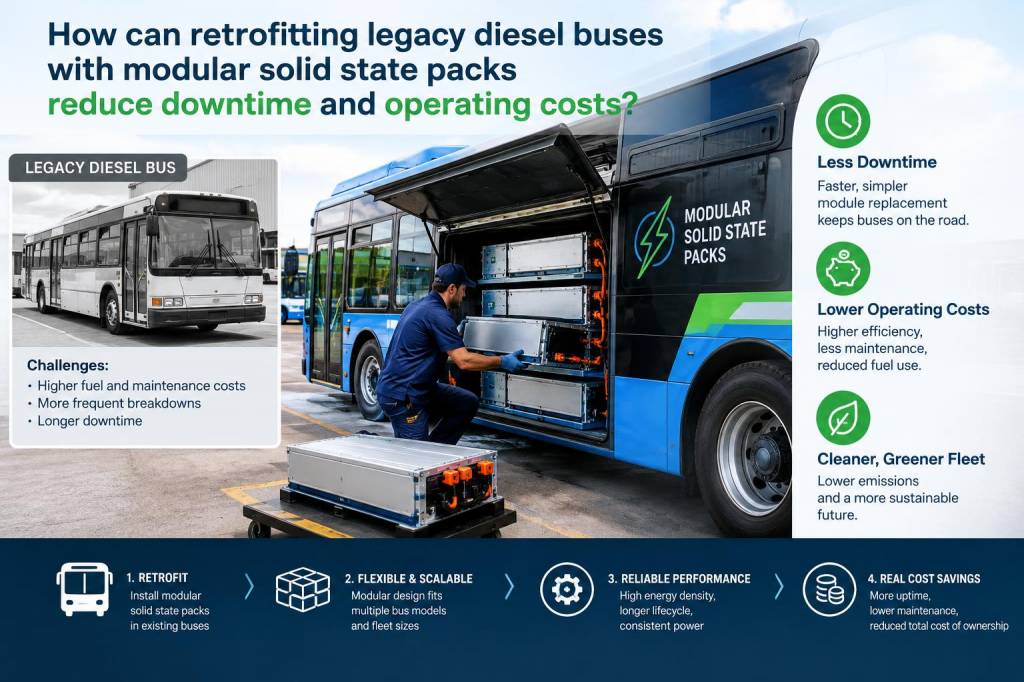
I’ve been watching city buses for years the way some people watch art — not for beauty but for what they represent: the practical spine of public life. Lately, I’ve become fascinated by a specific retrofit approach that promises to keep that spine strong while cutting costs and downtime: fitting legacy diesel buses with modular solid-state battery packs. In this piece I want to share what I’ve learned, the questions transit operators ask me, and why this approach might be one of the most pragmatic steps cities can take toward electrifying fleets without the massive disruption of fleet replacement.
Why retrofit diesel buses?
When I talk to transit agencies, the starting point is always pragmatic: budgets are tight, replacement cycles are long, and taking dozens of buses out of service to buy electric replacements is often politically and financially unrealistic. Retrofitting offers a middle path — extend the useful life of existing vehicles while gaining many of the emissions and fuel-cost benefits of electrification.
But not all retrofit strategies are equal. Swapping in a single, heavy battery pack under the floor can be invasive, expensive, and problematic for weight distribution and maintenance. That’s why modular solid-state packs are gaining attention: they’re lighter, compact, and designed to be plugged in or swapped out with minimal vehicle surgery.
What are modular solid-state packs?
In short, solid-state batteries replace the liquid electrolyte of conventional lithium-ion cells with a solid material, improving energy density and safety. Modular designs divide battery capacity into smaller, self-contained units that can be installed across the bus or clustered in accessible compartments.
The combination — solid-state chemistry in modular form — promises faster charging, lower fire risk, and the ability to remove or replace modules quickly when needed. For fleet managers, that translates to less downtime and more predictable maintenance.
How do they reduce downtime?
In practice, I’ve heard agencies report that modular systems can cut unexpected downtime by 30–50% compared with large, monolithic battery packs. That’s a huge operational benefit when schedules are tight and spare buses are limited.
What about operating costs?
Operating cost reductions come from several angles:
To make this tangible, I like to model a five-year view. Below is a simplified table illustrating relative costs per bus per year for a hypothetical mid-size transit agency switching from diesel to a retrofitted modular solid-state solution versus direct replacement with new electric buses.
| Retrofit w/ modular solid-state | Buy new EV bus | Legacy diesel (baseline) | |
|---|---|---|---|
| Capital cost (amortized/year) | $40,000 | $120,000 | $0 |
| Energy & fuel | $6,000 | $5,500 | $18,000 |
| Maintenance | $4,500 | $3,800 | $12,000 |
| Downtime / service loss | $2,000 | $1,200 | $5,500 |
| Total/year | $52,500 | $130,500 | $35,500 |
Numbers above are illustrative, but they show a key point: retrofitting can be cost-effective versus buying new EVs, while still delivering substantial operational savings over diesel.
Which technical hurdles should operators expect?
Retrofitting isn’t plug-and-play. In my conversations with engineers, common challenges include:
Working with experienced integrators — companies like Proterra (for retrofit programs), Siemens Mobility, or specialized integrators — significantly reduces these risks. Some startups focus specifically on modular battery retrofits and standardized interfaces, accelerating deployment.
Are solid-state modular packs ready for fleets today?
Solid-state technology is advancing quickly, but full commercial deployment in heavy-duty transit is still emerging. Many systems on the market now are advanced lithium-ion with ceramic separators or solid composite elements — effectively “solid-state-adjacent.” True all-solid-state batteries are promising but may still be limited by production scale and cost.
However, modular architecture can still be implemented today using high-density lithium-ion cells with robust packaging and advanced BMS. The modular approach future-proofs fleets: when true solid-state modules become cost-effective, they can be swapped in with minimal vehicle changes.
How should agencies pilot a retrofit program?
Regulatory and safety considerations
Operators must ensure retrofits meet local vehicle safety regulations and emissions standards. Fire code, crashworthiness, and crash-testing may be required for substantial structural changes. I always advise agencies to involve regulators from the start and document testing thoroughly — it streamlines approvals later.
Insurance and warranty arrangements are another practical area to address. OEM warranties may be voided by retrofit, so clear contracts with retrofit providers about performance guarantees and liability are essential.
What about environmental impact?
Retrofitting generally yields faster emissions reductions than waiting to replace fleets. Reusing chassis and components avoids the embodied emissions of manufacturing a whole new bus. When modules are designed for recyclability and second-life reuse, the lifecycle environmental footprint improves significantly.
I’ve seen several cities successfully combine retrofits with local renewable energy — charging modular packs with daytime solar or low-cost overnight renewable power to maximize carbon reductions and cost savings.
On Mobility News I’ll continue to track pilots and vendors pushing this space forward. For cities that need practical, cost-effective steps toward electrification, modular solid-state (or solid-state-capable) retrofits are an idea worth serious consideration — not a silver bullet, but a flexible tool in the transition toolbox.