I have always found traffic signals strangely revealing. At a glance, they look like simple devices that just stop and release cars, yet they quietly shape city life in ways most people never notice. When smart traffic lights begin to prioritize buses, bikes, and emergency vehicles, I see a shift that goes far beyond signal timing. I see a city choosing movement patterns that value people, public service, and speed where it truly matters.
What changes when priority is built into signals
Traditional traffic lights treat every direction and every road user in a fairly rigid way. A private car, a bus carrying dozens of passengers, a cyclist moving through a protected lane, and an ambulance racing to a hospital all wait inside a system that often assumes they deserve equal treatment. Smart traffic lights challenge that idea by using sensors, software, and real-time data to recognize who is approaching and what each movement means for the city.
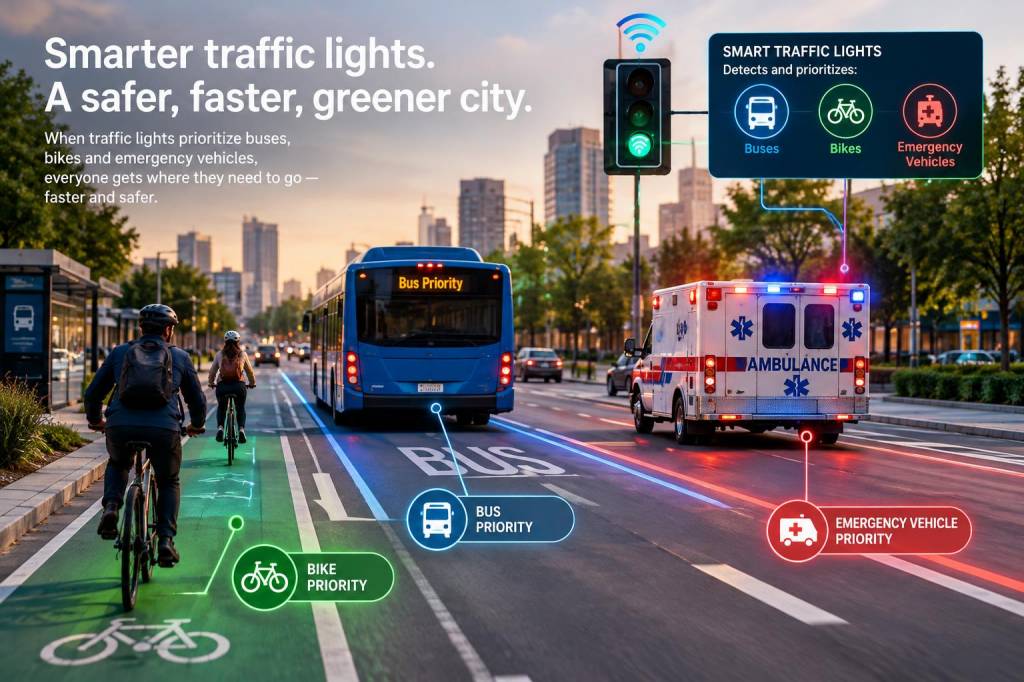
When I look at these systems, I think of them as a kind of urban decision-making layer. They can detect a bus running late, extend a green phase for a bicycle crossing, or clear a route for an emergency vehicle. That sounds simple, yet it changes the character of an intersection. Instead of managing only traffic volume, it manages urgency, efficiency, and shared mobility goals.
This is not just about moving vehicles faster. It is about moving more people more effectively. A bus with forty passengers deserves a different level of priority than a single-occupant car. A cyclist riding in traffic should not be forced to wait through a long, unnecessary cycle if a signal can safely accommodate a crossing. An ambulance should not lose precious seconds because a signal controller is still following a fixed schedule designed for normal conditions.
Why buses gain so much from signal priority
I think bus priority is one of the clearest arguments for smart signals, because buses are public infrastructure in motion. Every minute a bus spends sitting at a red light can ripple through an entire route. A late bus does not just inconvenience one rider; it can disrupt transfers, reduce reliability, and make the service feel less trustworthy.
With transit signal priority, a bus can trigger a longer green phase, shorten a red phase, or receive a special timing adjustment when it is behind schedule. Some systems use GPS data from the bus fleet, while others rely on roadside detectors or communication between vehicles and signals. In practice, this means buses can keep moving with fewer stops, smoother acceleration, and better schedule adherence.
I have noticed that this also improves the rider experience in subtle but important ways. People may not remember every intersection, but they remember whether a bus feels dependable. When signal priority works well, passengers see fewer pointless delays, less stop-and-go motion, and a more consistent trip. For cities trying to shift people away from private cars, that matters a great deal.
What cyclists notice first
Cyclists are often among the first to feel whether a city truly respects active transport. A bike lane is useful, but a bike lane paired with signal logic that ignores cyclists can still create frustration and danger. Smart traffic lights can help by recognizing bicycle volumes, timing crossings for slower speeds, and creating safer intervals for turning movements.
In some places, bicycle detection works through embedded pavement sensors, camera systems, or buttons designed for cyclists rather than drivers. In others, cities create bicycle-specific signal phases that give riders a clean crossing window. I see this as more than convenience. It is a statement that cycling is not an afterthought.
There is also a psychological effect. When a cyclist feels that an intersection has been designed with their presence in mind, that rider is more likely to keep using the network. If a city wants more people on bikes, it must remove the tiny punishments that accumulate at every junction. Long waits, awkward merges, and unpredictable car turns can discourage cycling even when infrastructure looks good on paper.
Why emergency vehicles may benefit most of all
If bus priority improves reliability and bike priority improves safety and comfort, emergency vehicle priority can save lives. This is where I think smart signals show their most compelling value. Ambulances, fire trucks, and police vehicles need a clear path, and every second matters when response time is on the line.
Modern systems can detect sirens, receive direct communication from emergency fleets, or use connected vehicle platforms to prepare a route in advance. A signal may turn green early, hold green longer, or prevent cross traffic from entering an intersection while the emergency vehicle passes through. In some cities, this happens automatically and locally. In others, it is coordinated through a central traffic management center.
I like that this does not require making every intersection permanently green for emergency services. Instead, it uses intelligence and timing. That is a much better model than simply forcing all traffic to wait all day for a rare emergency event. The system becomes responsive rather than blunt.
What drivers experience in mixed traffic corridors
Many people worry that prioritizing buses, bikes, and emergency vehicles will punish drivers. I understand that concern, because no one likes to feel trapped in a congested corridor while a signal appears to favor every other mode. Yet in practice, a well-designed system can improve overall flow rather than weaken it.
When buses run more reliably, fewer people choose to drive. When cycling feels safer and more predictable, more short trips shift to bicycles. When emergency vehicles clear intersections faster, the entire network avoids prolonged disruption. The result can be a steadier traffic pattern, not a worse one.
Still, balance matters. I have seen cases where poor calibration created frustration because signal priority was too aggressive or too sensitive. If buses are always favored without regard for side-street queues, nearby traffic can back up. If bike detection is inaccurate, riders can wait too long or receive poorly timed phases. Good smart signals need continuous adjustment, not just clever software.
What cities need behind the scenes
Smart traffic lights are only as effective as the data and governance behind them. I often think people imagine a signal simply “getting smarter,” but that hides a lot of work. Cities need accurate maps of lanes, signal cabinets that can support modern controllers, communications networks, maintenance teams, cybersecurity protections, and clear rules about who gets priority and when.
There is also a human layer. Transportation planners, transit agencies, emergency responders, engineers, and software vendors all need to coordinate. If a bus operator changes routes, if a bike corridor opens, or if a hospital district sees heavier ambulance demand, the signal strategy must adapt. Static settings will not hold up for long.
| Road user | Signal behavior | Expected city benefit |
|---|---|---|
| Bus | Green extension or early release | Better reliability and fewer delays |
| Bike | Dedicated crossing phase or detection-based timing | Safer, smoother rides |
| Emergency vehicle | Preemption or rapid route clearance | Faster response and improved safety |
| Private car | Adjusted timing within wider network logic | More predictable flow and fewer gridlock events |
What people often ask about fairness
One of the most common questions I hear is whether priority systems are fair. My answer is that fairness in mobility is not about giving every mode identical treatment. It is about giving each mode an appropriate role in the city. A bus that carries many people deserves operational support. A cyclist who contributes almost no local pollution should not be sacrificed for comfort convenience. An ambulance must not wait for a fixed cycle when a life may depend on speed.
Fairness also depends on location. A dense downtown corridor may need aggressive bus priority because public transport carries a large share of trips. A school zone may need cycling and pedestrian protection first. An industrial district may need emergency access and freight coordination. A smart signal system can reflect these local conditions instead of imposing one rule everywhere.
That said, I believe transparency is essential. Residents should know why a signal behaves a certain way, what data is used, and how performance is measured. If a city asks people to accept more nuanced priority, it should also explain the logic clearly. Otherwise, trust erodes quickly.
What this means for the future of urban mobility
I see smart traffic lights as a practical bridge between infrastructure and policy. Cities often talk about making transportation cleaner, safer, and more equitable, but those goals can feel abstract until they appear at an intersection. When a signal gives a bus a fair chance to stay on time, a cyclist a safer crossing, and an emergency vehicle a clear route, policy becomes visible.
That visibility matters because people notice mobility through friction. They notice when a bus is late. They notice when a bike crossing feels dangerous. They notice when sirens pile up behind a red light. Smart signals can remove some of that friction, and when they do, a city starts to feel more responsive and less wasteful.
I also think these systems will become more adaptive over time. Connected vehicles, computer vision, edge computing, and machine learning are already making intersections more responsive than they were even a few years ago. In the future, I expect signals to react not only to vehicle type, but also to occupancy, network conditions, weather, construction, school schedules, and event surges.
What excites me most is not the technology itself, but the choice behind it. A city that prioritizes buses, bikes, and emergency vehicles is saying something important about who and what it values on its streets. That choice can reshape daily life, one intersection at a time.