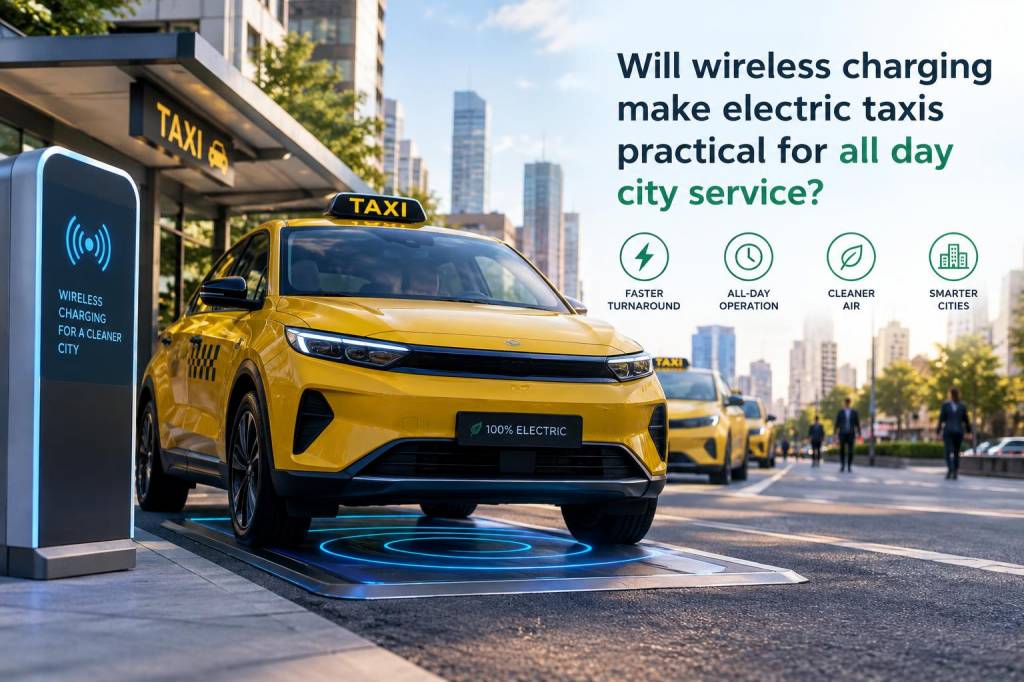
I keep coming back to one question whenever I look at the future of urban electric fleets: can wireless charging make electric taxis practical for all-day city service? In my view, this is one of the most important questions in mobility right now, because a taxi does not behave like a private car. A taxi works for long hours, stops often, and rarely sits still for a full, convenient charging session. That difference changes everything.
For a private EV owner, plugging in overnight is usually enough. For a taxi, every minute spent charging is a minute not earning revenue. That is why wireless charging feels so promising. If a driver could simply pull into a designated bay, stop for a few minutes, and receive energy without cables, the vehicle could spend far more time in service and far less time waiting around. That sounds ideal, but I think the real answer is more nuanced than a simple yes or no.
Why taxi duty is a very hard test for electric vehicles
Taxi operations are brutal from an energy standpoint. A city taxi can spend hours in stop-and-go traffic, with air conditioning running, passengers entering and leaving, and constant acceleration. That pattern is much tougher than highway driving in some ways, because the battery is being used all day while the vehicle idles in traffic and serves short trips. Range anxiety becomes not just a personal worry, but a business problem.
When I think about all-day service, I think in terms of uptime. A taxi company wants a car on the road as long as possible, with enough battery reserve to avoid disruptions. Today, that usually means one of two strategies: very large batteries, or scheduled fast charging. Large batteries add weight and cost, while fast charging can still interrupt service and stress the battery over time. Wireless charging offers a third path, and that is what makes it so interesting.
What wireless charging could actually solve
Wireless charging could fit naturally into the rhythm of taxi work. In an ideal city setup, a taxi might charge during short breaks, queue time, meal breaks, rank waiting, or while parked at high-demand zones. Instead of one long charging stop, the vehicle could gain energy in smaller bursts throughout the day. That would help smooth out battery use and reduce the need for massive overnight top-ups.
I also see a major benefit in driver simplicity. There is no cable to handle, no connector wear in harsh weather, and no need to exit the car for a plug-in routine. For a fleet operator, that can mean more predictable behavior and less daily friction. In a profession where time matters, even a small reduction in operational hassle can have a real effect.
Another possible advantage is safety and durability. Cables on busy taxi ranks can be awkward, especially in wet weather or crowded curbside areas. A wireless system, if designed well, can reduce trip hazards and physical wear. It may also feel more robust in a commercial environment where equipment gets used constantly and roughly.
Static pads versus in-motion charging
When people talk about wireless charging, they often imagine one of two systems. The first is static charging, where a vehicle parks over an embedded pad. The second is dynamic charging, where coils are placed under a road surface so vehicles can charge while moving. For taxis, static systems seem far more realistic in the near term.
Dynamic charging is fascinating, but it requires major infrastructure investment and careful coordination with city roadworks. That is a much bigger leap than installing pads at taxi depots, airports, rail stations, hotels, and busy pickup zones. If I were planning a pilot program, I would start with static wireless pads in controlled locations where taxis naturally pause for short periods.
In practice, that could look like this:
- Taxi stands with embedded charging pads
- Airport pickup and queue areas
- Central fleet depots for overnight and daytime top-ups
- Staging zones near major transport hubs
- Priority lanes or waiting areas for ride-hailing fleets
Is the charging speed enough for city service?
This is where the discussion gets serious. Wireless charging is convenient, but convenience alone does not pay the bills. The key question is whether the power transfer rate is high enough to support a taxi that spends all day in motion. At present, wireless systems generally deliver less power than the fastest wired DC chargers, and efficiency losses can also be a concern. That matters because taxi economics depend on getting meaningful energy in a short dwell time.
Still, I do not think we should measure wireless charging against a perfect fantasy. A taxi does not always need a full battery refill in one session. It often needs steady energy replenishment to keep the state of charge in a healthy band. If a system can add enough range during every short stop, the car may never need a large emergency charge during working hours.
That said, the numbers have to work. If a taxi gains only a tiny amount of energy from each stop, then the infrastructure may not justify its cost. The sweet spot is a system that is fast enough to matter, efficient enough to be economical, and simple enough to integrate into daily fleet operations.
| Factor | Wireless charging advantage | Main limitation |
|---|---|---|
| Driver convenience | No cable handling, quick parking and charging | Requires precise vehicle alignment |
| Fleet uptime | Can add energy during short breaks | May not replace all fast-charging needs |
| Infrastructure | Cleaner curbside experience | High installation cost |
| Battery wear | Potentially fewer extreme fast-charge sessions | Efficiency losses still matter |
| Maintenance | Less connector wear and fewer exposed cables | Pad upkeep and alignment systems required |
What fleet operators will care about first
When I speak about mobility with fleet logic in mind, I always return to total cost of ownership. That includes vehicle price, battery size, charging hardware, grid upgrades, maintenance, downtime, insurance, and labor. Wireless charging must compete on all of those dimensions, not just on novelty.
Fleet operators will likely ask several practical questions:
- Will the system reduce downtime enough to justify installation?
- Can it work with existing taxi models or only special vehicles?
- How much power is delivered per minute?
- Will the city support enough charging locations for real coverage?
- Does the added convenience outweigh the higher upfront cost?
In my opinion, the first deployments will probably happen where taxis already spend time waiting. Airports are a natural candidate. So are large rail stations, major business districts, and fleet depots. These sites create predictable dwell times, which makes wireless charging more valuable than in random curbside use.
Battery size could shrink if charging becomes frequent
One of the most exciting possibilities is that wireless charging could allow smaller batteries in taxi fleets. If a vehicle can recover energy multiple times per shift, it may not need an oversized pack just to survive a full working day. Smaller batteries mean lower vehicle weight, lower material use, and potentially lower purchase prices. That could change the economics of electric taxis in a meaningful way.
Of course, smaller batteries only work if the charging network is reliable. If charging points are unavailable during a busy shift, the whole model falls apart. So I see wireless charging not as a stand-alone solution, but as part of a managed urban energy system. It works best when a city, fleet operator, and vehicle supplier plan together.
Where wireless charging still has real obstacles
I would not pretend this is effortless. There are several barriers that still make me cautious. Installation is expensive, particularly if cities need to cut into streets or upgrade electrical capacity. Efficiency is another issue, because every energy loss adds cost. There is also the matter of standardization: fleets need confidence that different vehicle brands and charging sites can communicate consistently.
Weather and road conditions matter too. Urban environments are dirty, wet, and demanding. Any system buried in asphalt must withstand constant stress from heavy vehicles, road salt, vibration, and maintenance work. If the infrastructure fails too often, taxi operators will lose trust quickly.
I also think about equity. If only premium fleets or wealthy districts get access to wireless taxi charging, then the benefits may remain limited. For real city impact, the network has to serve broad commercial use, not just showcase projects.
My view on whether it can become practical
My answer is yes, but with conditions. Wireless charging can make electric taxis practical for all-day city service if it is deployed in the right places, at the right power levels, and with the right operational model. I do not think it will instantly replace wired fast charging, and I do not think every taxi will rely on it. But for fleets that operate in dense cities with predictable stopping patterns, it could become a very effective part of daily service.
What excites me most is not a future where taxis never plug in at all. It is a future where charging becomes almost invisible, woven into the natural flow of work. A taxi arrives, pauses, picks up energy, and moves on. If cities can make that happen at scale, electric taxis stop feeling like a compromise and start looking like a mature urban transport solution.
And from where I stand, that shift matters far beyond taxis. It could influence how cities think about curbside space, fleet design, grid planning, and the role of software in coordinating energy use. Wireless charging is not just a hardware story. It is a software and systems story too, which is exactly why it belongs at the center of the mobility conversation.