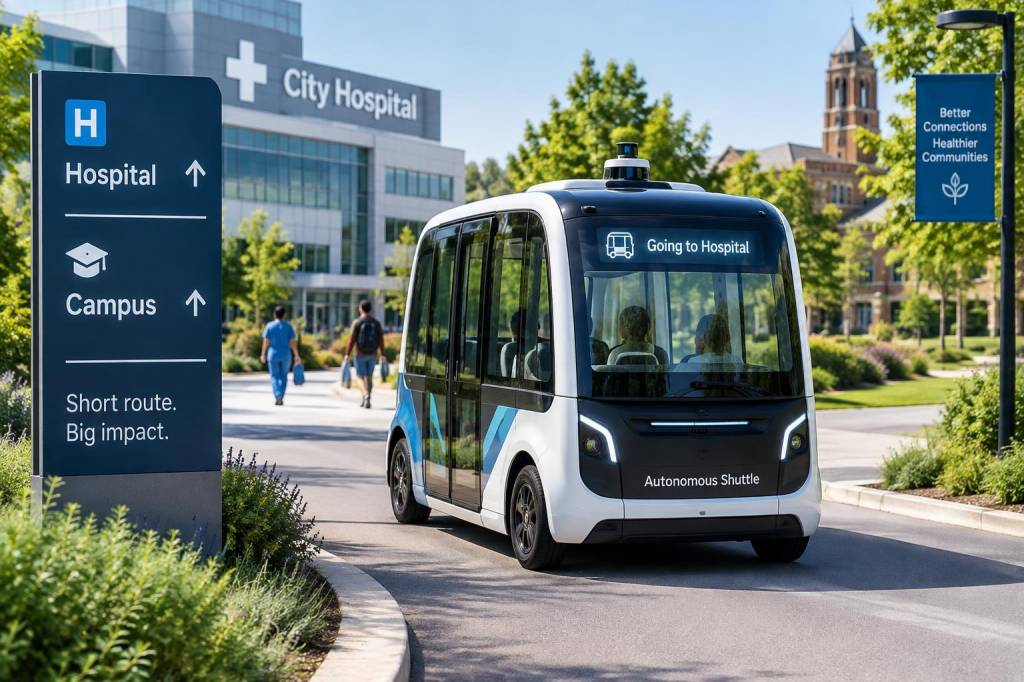
When I look at the current wave of autonomous mobility projects, I am struck by how often they begin in places that are smaller, more controlled, and more practical than a downtown corridor. Hospital campuses and university grounds keep appearing in pilot programs for a simple reason: they offer a real transport problem that autonomous shuttles can solve without needing to tackle every complexity of a full city street network on day one. From my perspective, that makes them one of the most useful proving grounds for this technology.
City planners are not testing these shuttles because they want a headline. They are testing them because these short routes reveal whether an autonomous system can deliver reliable service where people actually need it. A hospital shuttle has to move patients, visitors, staff, and sometimes mobility-impaired riders. A campus shuttle has to keep schedules, handle frequent stops, and operate safely among pedestrians, cyclists, delivery vehicles, and service traffic. These are not glamorous routes, but they are demanding in all the right ways.
Why short routes matter so much
I often hear people ask why planners do not begin with something bigger, like a full autonomous bus network across an entire metropolitan area. My answer is that short routes reduce risk while still producing meaningful data. On a hospital or campus loop, an autonomous shuttle can repeat the same path many times each day, which helps planners study performance, safety, passenger behavior, and service reliability in a measurable way.
That repetition matters. A shuttle that circulates between a parking structure, a main entrance, and a clinic can encounter the same intersections, the same turning angles, and the same pickup points over and over again. If there is a problem, it becomes easier to identify whether it comes from mapping, weather, pedestrian density, sensor behavior, or human interaction at boarding points. For city planners, that clarity is valuable. They are not just asking whether autonomy can work in theory; they are asking whether it can handle a specific environment with consistency.
There is also a practical budget reason. Shorter pilot corridors are less expensive to define, monitor, and support. Instead of redesigning an entire district, planners can create a small operational zone and build service around it. That lets them test everything from lane markings to curb design to passenger information systems without waiting for a full-scale infrastructure transformation.
What hospitals and campuses reveal about real-world autonomy
Hospitals are among the most revealing places for autonomous shuttle trials because the human stakes are obvious. People arriving for treatment may be anxious, tired, in pain, or carrying medical equipment. Visitors may not know where to go. Staff members often move quickly between buildings and need dependable service that respects shift schedules. In that setting, a shuttle is not just a novelty; it becomes part of the way the site functions.
I find campus environments just as interesting, even though they feel different on the surface. Universities and research parks combine foot traffic, bike traffic, delivery access, and periodic surges between classes or events. They also create a good test for rider trust. Students and staff are usually comfortable with new technology, but comfort does not equal acceptance. If a shuttle arrives late, stops too abruptly, or creates confusion at a crossing, people notice immediately. That feedback is useful, because public acceptance will shape whether autonomous mobility expands beyond pilots.
These environments also highlight something important that people sometimes overlook: autonomy is not only about driving. It is about service design. A shuttle can have excellent sensors and still fail if boarding is confusing, accessibility is poor, dispatch is unreliable, or route planning ignores rider needs. I think that is why planners like these pilot sites. They reveal whether the whole service model works, not just the vehicle itself.
Safety, trust, and the learning curve
Safety is usually the first concern raised in any conversation about autonomous vehicles, and rightly so. When planners choose a hospital or campus route, they are not claiming the area is easy. They are choosing a route where the environment can be studied and managed closely. That usually means lower speeds, more predictable traffic patterns, and a stronger operational support team nearby.
From my point of view, this is where many pilots earn their value. They let engineers and planners observe what happens when a shuttle approaches a crosswalk with a high volume of pedestrians, or when a delivery truck blocks part of a lane, or when weather changes visibility and traction. Every one of those moments teaches something. And because the routes are short, operators can quickly adjust signage, mapping, stop placement, or passenger guidance.
Trust grows slowly in these settings. Riders need to see that the shuttle can stop smoothly, respond clearly, and behave in a way that feels predictable. They also need to know what to do if they want to alert someone, exit early, or get help. In my experience, this human layer is often what determines whether a pilot succeeds. People do not judge autonomy only by technical accuracy. They judge it by whether it feels dependable in everyday use.
Why planners value data from limited environments
One of the reasons I follow these projects closely is that they produce a kind of operational data that cities rarely get from traditional transport planning. A shuttle on a hospital loop can generate information about dwell time, boarding patterns, peak demand, route delays, and passenger preferences. A campus shuttle can show when service is too infrequent, where people wait, and which stops attract the most riders.
That data helps planners answer questions that matter for future deployment:
- Where do passengers actually want pickup and drop-off points?
- How much service frequency is enough to make people use the shuttle instead of walking or driving?
- Which intersections or curb zones create operational friction?
- How do riders react to a vehicle with no driver behind the wheel?
- What accessibility features are essential for confidence and inclusion?
These questions sound simple, but they are central to scaling autonomous transport. A city may eventually want these systems on broader streets, but it needs evidence before it can justify that leap. Short hospital and campus routes provide that evidence in a form that is concrete, repeatable, and easy to analyze.
Accessibility is a major reason these pilots matter
I think accessibility is one of the strongest arguments in favor of autonomous shuttles on controlled routes. In a hospital setting, every minute saved and every barrier removed matters. A shuttle that connects parking, entrances, clinics, and transit stops can reduce walking distance for people who already have enough to manage. On a campus, it can support people with temporary injuries, chronic conditions, heavy equipment, or mobility limitations.
What I like about these pilots is that they force planners to think beyond a narrow definition of efficiency. A shuttle may be technically capable of moving people quickly, but if the seating, boarding, communication, or stop spacing excludes part of the population, then the service is incomplete. Accessibility is not an afterthought in these environments. It is one of the reasons the service exists at all.
That is why I pay attention to whether pilots include low-floor boarding, clear visual and audio messaging, space for mobility devices, and simple request systems. These design choices may seem small, but they determine whether the shuttle feels like public transport or a tech demonstration.
Operational realities planners cannot ignore
There is a tendency to imagine autonomous shuttles as clean, quiet, and almost effortless once they are deployed. In reality, they require active planning and ongoing supervision. Someone has to think about maintenance, cleaning, software updates, remote monitoring, route changes, and emergency procedures. Someone also has to coordinate with the institution hosting the pilot, whether that is a hospital administration or a university transport office.
I have seen enough mobility projects to know that success often depends on these unglamorous details. If a shuttle is unavailable during shift changes, it loses credibility. If a campus route does not align with class schedules, ridership drops. If a hospital pilot ignores wheelchair access at the boarding point, the service misses the people who may need it most.
Planners also have to balance experimentation with predictability. A pilot should feel innovative, but it should not feel unstable. Riders need to know where the shuttle goes, when it arrives, and what it will do in unusual situations. That balance is one of the hardest parts of deploying autonomous service in public-facing environments.
| Route setting | Main advantage | Main challenge |
| Hospital campus | High usefulness for patients, visitors, and staff | Accessibility, sensitivity, and schedule pressure |
| University campus | Dense demand and repeatable traffic patterns | Pedestrian flow, event surges, and timetable alignment |
| Research park | Controlled environment with practical commuting needs | Maintaining enough ridership outside peak hours |
What I think these pilots are really preparing for
When I look at autonomous shuttles on short hospital and campus routes, I do not see a final destination. I see a testing ground for a new public transport logic. These pilots are teaching cities how to integrate autonomy into everyday mobility without demanding an immediate leap into fully mixed urban traffic.
They are also helping decision-makers understand something subtle but important: people will adopt autonomous transport when it solves a real problem better than the existing options. A shuttle that reduces walking distance, improves access, fills service gaps, and remains dependable can build support in a way that a flashy demonstration never could.
I believe that is why these routes keep attracting attention. They sit at the intersection of technology, public service, and urban design. They are small enough to manage, yet complex enough to matter. And for planners trying to understand where autonomous mobility belongs in the city, that combination is hard to beat.