I’ve ridden more than my share of shuttles up and down steep urban corridors, and I’ve watched transport operators wrestle with one question again and again: on hilly routes, do hydrogen fuel-cell microbuses or battery-electric shuttles make more operational sense? The answer isn’t binary. It depends on gradients, duty cycles, depot capacity, and even local politics. Below I unpack the main trade-offs I’ve observed, with practical details operators and planners will care about.
Energy and range dynamics on hills
Hills are unforgiving for any electric drivetrain because climbing requires sustained power and frequent regenerative braking. In my experience, the two technologies respond differently.
Battery shuttles tend to show a steep drop in usable range on routes with repeated climbs. Batteries deliver high peak torque, which is great for hill starts, but the energy consumed climbing is energy that must be stored somewhere. Regenerative braking helps on descents, but heat and friction losses reduce recovery, and short, stop-start descents rarely recover all the energy spent climbing.
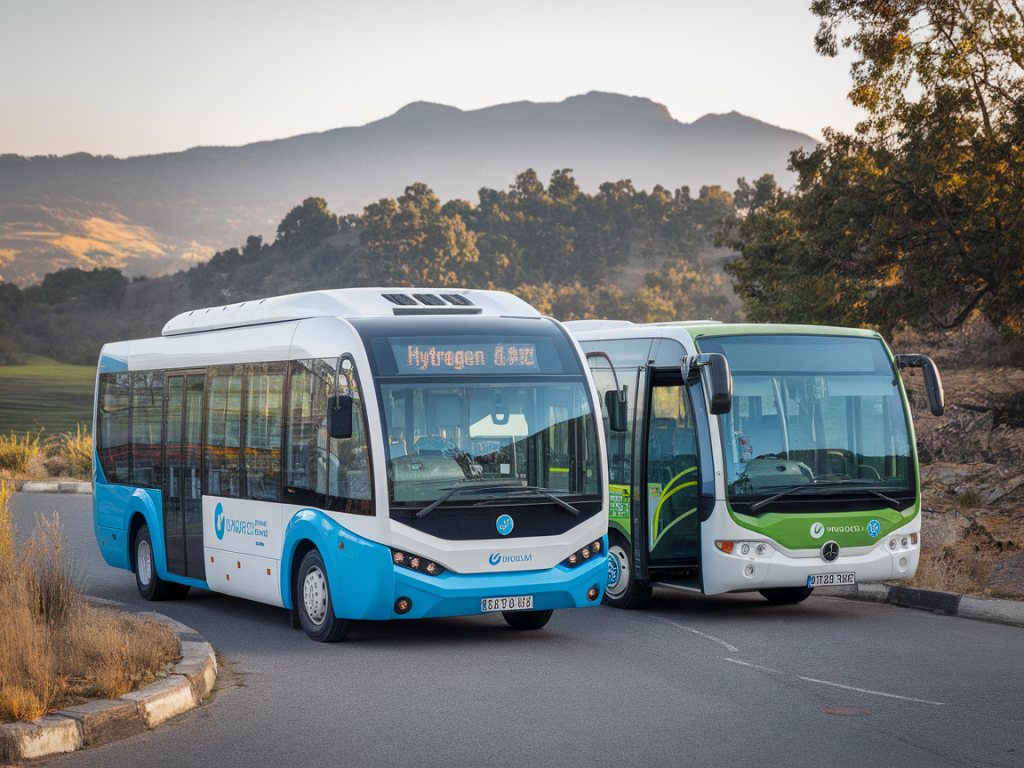
Hydrogen fuel-cell microbuses convert hydrogen to electricity on-board and typically have a lighter decline in range over hilly terrain compared with a similarly sized battery pack. Because refueling is fast and the hydrogen tanks hold a high energy density by mass, operators sometimes see more consistent range day-to-day on steep routes. That consistency matters when schedule adherence is critical.
Refueling vs recharging: operational tempo
One practical difference I always flag with transit managers is turnaround time.
- Hydrogen refueling can be done in roughly the same time as a diesel fill—often under 15 minutes for a microbus depending on station throughput. That means vehicles can return to service faster without expensive opportunity charging infrastructure being required en route.
- Battery recharging strategies vary. Depot overnight charging is cheap and simple, but if a battery shuttle cannot complete a full day on a hilly route, operators must add high-power opportunity chargers on route or adopt battery swapping. Opportunity charging introduces dwell time and infrastructure costs and can complicate driver schedules.
From an operations planning view, hydrogen offers simpler midday logistics—if you have access to hydrogen stations. Batteries require careful charge-management software and sometimes route rotation to balance energy use across the fleet.
Weight, payload and vehicle performance
Weight is another trade-off I watch closely. Batteries are heavy, and on a steep route that means more energy spent climbing.
- Battery shuttles often sacrifice passenger payload or require larger chassis to maintain capacity if operators want sufficient range on hills.
- Hydrogen systems (fuel cells + hydrogen tanks) are lighter for an equivalent range by mass, although tanks and compressed gas systems require careful packaging. For microbuses where interior space and passenger numbers are tight, hydrogen can preserve payload better.
That said, battery technology is advancing rapidly with higher energy density chemistries and lighter vehicle designs. For short, frequent trips with predictable stops, modern battery shuttles can be highly effective.
Infrastructure, depot footprint and supply chain
Where hydrogen often loses or wins depends on infrastructure.
Installing a hydrogen refuelling station is capital intensive and requires safety planning, approvals, and a reliable hydrogen supply chain. I’ve seen operators delay projects by months waiting for permits. Conversely, high-power chargers for batteries also demand significant grid upgrades and space at depots. You may need transformers, substations, or even microgrids to avoid peak demand penalties.
Here’s a concise comparison I’ve used with clients and planners:
| Hydrogen Fuel-Cell Microbus | Battery Shuttle | |
|---|---|---|
| Depot footprint | Smaller vehicle charging footprint; requires H2 storage/dispensers and safety zones | Large electrical infrastructure, multiple high-power chargers, potential for staging |
| Refuelling/recharging time | ~10–20 minutes | Overnight (hours) or fast charging 20–60 minutes with high-power chargers |
| Grid dependency | Lower daily grid draw if hydrogen delivered; generation decoupled | High grid draw; vulnerable to electricity price spikes and capacity limits |
| Range consistency on hills | More stable | More variable; reduced range if gradients repeated |
Costs: capex and opex realities
Cost comparisons are nuanced. Upfront vehicle costs for hydrogen fuel-cell microbuses are generally higher today than battery equivalents at the microbus scale, partly due to limited production volumes and the complexity of fuel cell stacks. However, operating costs depend heavily on local energy prices.
If electricity is expensive, or if dynamic pricing makes mid-day charging costly, hydrogen (particularly if produced at scale or via cheaper sources) can offer predictable fuel costs. But hydrogen production, compression, and delivery add layers of cost and emissions complexity—more on that in the next section.
Environmental footprint and real-world emissions
I always caution readers that “zero-emission” on the tailpipe isn’t the whole story.
For battery shuttles, the electricity’s carbon intensity matters. On a grid with high renewable penetration, batteries are very attractive. In regions where electricity still comes from fossil fuels, the lifecycle benefit shrinks.
For hydrogen, “green hydrogen” produced by electrolysis using renewables or “blue hydrogen” with carbon capture determine the environmental outcome. I’ve seen pilot projects where hydrogen was made from natural gas without adequate carbon mitigation, which undermines the low-emission rationale.
Maintenance, reliability and fleet management
Fuel cells add a layer of complexity for maintenance teams unfamiliar with high-pressure gas systems, but they have fewer moving parts than internal combustion engines and some electric drivetrains. Battery systems require thermal management and cell monitoring; thermal runaway risk is low but not negligible and requires trained technicians.
From a reliability standpoint on hilly routes, batteries can suffer faster degradation if consistently stressed by aggressive climbs and high charge/discharge cycles. That can reduce usable capacity over years and force earlier battery replacements.
Operational flexibility and route planning
For operators I advise, the question becomes: what is the acceptable operational complexity?
- If you need quick turnarounds and full-day range on steep terrain without adding chargers en route, hydrogen often looks compelling.
- If your network allows depot charging overnight and routes are short or allow scheduled charging breaks, battery shuttles can be simpler, cheaper, and increasingly reliable.
- Hybrid approaches are emerging—some operators combine battery-electric vehicles with a small number of hydrogen microbuses on the steepest sub-routes to avoid oversized batteries across the whole fleet.
Real-world examples and manufacturers
I’ve tracked pilots from Wrightbus (fuel-cell buses), Toyota and Hyundai (fuel-cell tech), and battery solutions from BYD and Proterra. In European hilly towns, a mix of battery and fuel-cell vehicles is appearing: battery shuttles for flatter circulators and fuel-cell microbuses tackling the steep feeder lines into hilltop neighbourhoods. That mixed strategy is something I often recommend: leverage the strengths of each technology where they fit best.
Deciding between hydrogen fuel-cell microbuses and battery shuttles on hilly routes isn’t just a technical selection—it’s an operational strategy. Consider energy sources, depot and charging/refuelling constraints, vehicle payload, and the long-term plan for emissions. For many operators I speak to, the smart move is not to pick a single winner but to design a fleet and infrastructure that play to local topography and energy realities.