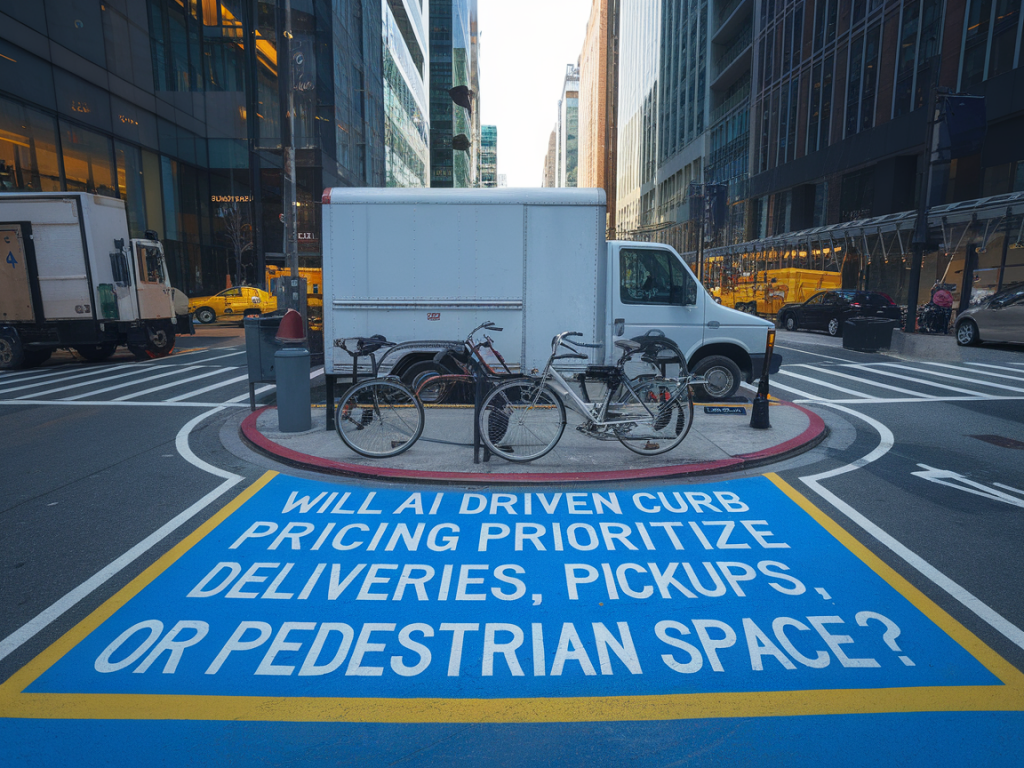
When I walk through a dense downtown, I often find myself watching how space at the curb is fought over: delivery vans idling, ride-hail cars double-parking for quick drop-offs, cyclists and scooters zig-zagging, and pedestrians squeezed onto narrow sidewalks. As cities lean into smart-city technologies, AI-driven curb pricing is becoming a proposed lever to reorder those priorities. The question I keep asking is: will this tech prioritize deliveries and pickups, or give back space to people on foot?
What is AI-driven curb pricing?
Curb pricing means dynamically charging vehicles for using curb space — stopping, parking, or lingering — based on demand, time of day, or the goals set by city managers. Throw AI into the mix and you get systems that predict need, adjust prices in real time, and decide which uses should be privileged at a given moment. Rather than static loading zones, you could have an adaptive curb that switches between commercial loading, short-term passenger pickups, or active public space depending on patterns learned from data.
How AI changes the policy game
I see AI as both an optimizer and an amplifier. Where traditional curb policy responds slowly — months or years to change signage — AI coupled with sensors and connected apps can react in minutes. That opens possibilities:
These sound like wins, but the priorities embedded in the AI — the objective function — determine who wins and who loses. That's where I think the debate really is.
Deliveries vs pickups vs pedestrians: the trade-offs
When designing a curb pricing system, cities and vendors choose trade-offs. From my urban planning background, I break them down like this:
| Priority | Benefits | Risks |
|---|---|---|
| Deliveries (freight) | Improves logistics efficiency, reduces circling, supports local businesses | May privilege commercial interests, increase truck presence and noise |
| Pickups (ride-hail, taxis) | Reduces double-parking, speeds passenger flows, lowers congestion | Encourages car trips, may displace active travel modes |
| Pedestrian/Public space | Improves placemaking, safety, economic activity from foot traffic | Limits curb access for businesses and riders; enforcement challenges |
Let me give a concrete example: if AI prioritizes deliveries during the 6–10 AM window, heavy goods vehicles get preferred curb access, which can shorten their dwell time and reduce traffic caused by searching for loading zones. But that same decision can squeeze morning pedestrian flows if sidewalks remain narrow, or leave commuters with fewer convenient pickup spots for carpooling or paratransit.
What determines the AI’s priorities?
Several factors shape the outcome. I always ask: who sets the objective function?
In short, AI doesn’t have intrinsic values. It reflects whoever programs the reward signals and trains the models.
Technology and data: what makes it work
I’ve looked at the tech stack closely. Effective AI-driven curb pricing is a blend of:
Companies like Coord and Xerox's Smart City platforms have experimented with digital curb management. Meanwhile, routing firms and aggregators — Amazon Logistics, UPS, local couriers — provide data that can make predictions more reliable. But accurate prediction is only half the problem; compliance and enforcement are the other half. AI might tell trucks where to park, but without cameras, digital permits and effective fines, behavior won't change.
Equity, privacy and public trust
I’m especially concerned about equity. Dynamic pricing can be progressive if revenue funds transit or pedestrian upgrades, but it can also be regressive if low-income workers or small businesses face higher fees while large platforms buy priority slots.
From my perspective, successful programs pair AI pricing with strong governance: published objectives, auditability of algorithms, clearly earmarked revenues, and community input loops.
Deployment models I’d support
If I had to sketch models that balance needs, I’d favor hybrid and contextual approaches:
Examples and early lessons
Cities like Seattle, San Francisco, and London have piloted digital curb management. From what I’ve observed, pilots that included community stakeholders and clear performance metrics performed better. When pilots were predominantly vendor-led and revenue-focused, pushback was swift.
One striking trend is platform behavior: logistics and ride-hail firms will adapt their routing and incentives (e.g., surge for couriers to avoid high-priced curbs). This means curb pricing can shift, not eliminate, congestion — unless it’s coordinated with routing rules and loading zone design.
At Mobility News, I continue to follow pilots across Europe and North America. The real opportunity, to my mind, is not merely to squeeze extra revenue from curbside transactions but to use AI to choreograph curb space in service of broader urban goals: safety, accessibility, and livability.