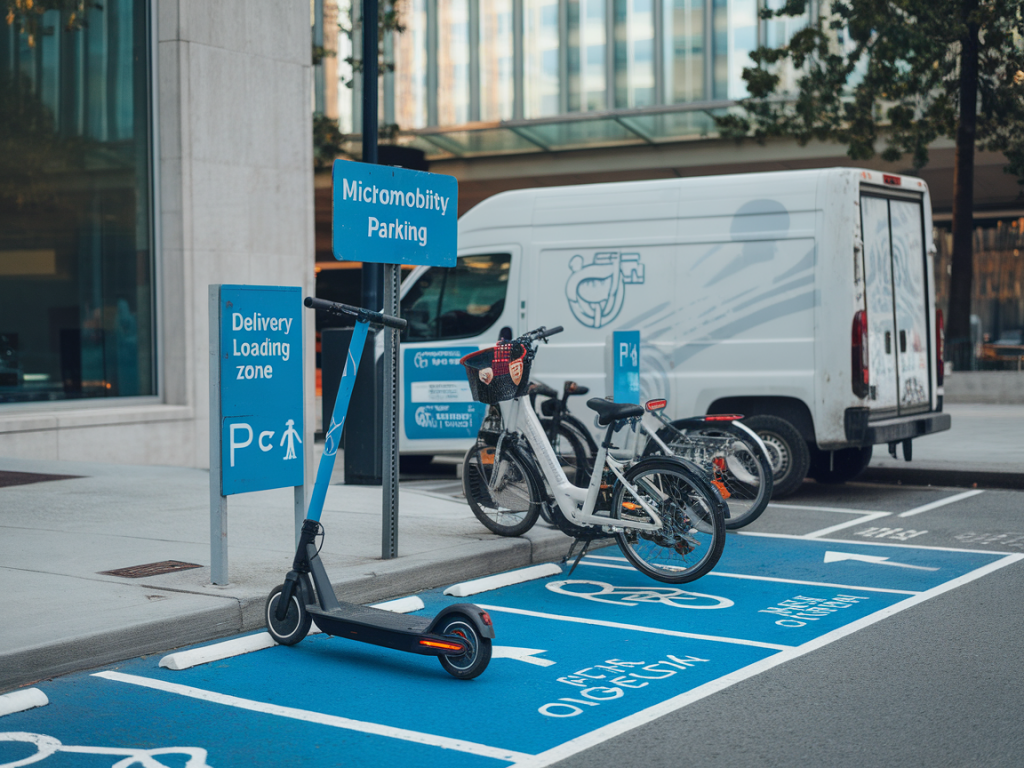
I’ve been watching the rise of micromobility and the explosion of delivery services for years, and one thing keeps coming up in conversations with planners, operators and riders: the curb is clogged. As cities densify, we’re asking the same narrow strip of real estate to serve scooter parking, e-bike docks, taxi stands, parcel lockers, food delivery loading zones and more. Curbside AI enforcement promises a way to manage that chaos, but it raises questions about fairness, privacy and real-world practicality. In this piece I want to explore how AI can help balance micromobility parking with delivery loading zones — and what it must do right to actually work for people.
Why the curb matters
The curb is the interface between private vehicles and public space. That means it determines how efficiently people move goods and themselves. When a bike-share scooter is left in a narrow sidewalk, pedestrians suffer. When delivery riders double-park by a storefront, traffic and transit flow slow. I’ve seen neighborhoods where resident complaints about blocked sidewalks eclipse even noise or parking taxes — the curb directly affects quality of life.
What curbside AI enforcement actually is
When people talk about curbside AI enforcement, they’re usually referring to systems that combine sensors, cameras, computer vision and automated decision logic to detect violations and either notify users, issue digital warnings, or trigger fines. These systems can be stationary (camera mounted on light poles) or mobile (mounted on enforcement cars or even integrated with micromobility vehicles). The AI component is largely about real-time detection and classification: is that object a docked e-bike, a scooter in the pedestrian zone, a delivery van in a loading bay, or an unattended parcel?
Balancing priorities: micromobility vs. delivery
There are at least three conflicting needs at play:
- Short-term delivery access: Businesses need quick curb access for pickups and drop-offs.
- Micromobility parking: Riders need convenient and safe places to leave e-scooters and bikes.
- Pedestrian accessibility and safety: Sidewalks must remain passable.
AI can help by making enforcement dynamic rather than static — distinguishing between legitimate stops and abuse, adapting rules by time of day and detecting patterns rather than just issuing blanket tickets.
Practical AI features that make a difference
From my conversations with product teams at companies such as Clearview (hypothetical) and mobility operators like Lime and Bird, a few technical features consistently stand out:
- Context-aware detection: The AI must understand context — a courier stopped in front of a restaurant during lunchtime is different from a vehicle blocking a bus stop. Temporal models help.
- Object-level classifications: It should differentiate between micromobility devices, boxes, vehicles, and human obstruction.
- Geo-fenced policies: Rules should vary by curb type — loading zone, residential, commercial, school — and map data must be accurate.
- Grace periods and warnings: Rather than instant fining, tiered enforcement (warnings, nudges to move, fines) improves compliance and public trust.
- Auditability and human review: To avoid false positives, there should be logs and a rapid appeals process involving humans.
Use cases where AI enforcement adds value
A handful of scenarios illustrate the potential:
- Dynamic loading zones: AI detects peak delivery windows and temporarily designates curb lanes for loading, alerting drivers via parking apps.
- Smart micromobility parking: When a scooter is left incorrectly, the operator receives a precise image and location and can nudge the user through the app to repark it in a dedicated bay.
- Conflict resolution: AI flags continual misuse (e.g., delivery vehicles habitually blocking bike racks) so enforcement resources can be targeted.
- Data-driven planning: Aggregated curb use data helps cities redesign curbs — creating more formal loading zones or increasing bike corrals where needed.
Privacy, bias and trust issues
I’m often asked about privacy. Cameras and AI inevitably raise concerns — who stores the footage, for how long, and who can access it? To build public trust, systems must minimize personally identifiable data, implement on-device processing where possible, and have clear data-retention policies. Openly published models and independent audits can also mitigate concerns about bias in enforcement decisions.
Equity and accessibility considerations
AI systems can unintentionally disadvantage couriers on low incomes, people who rely on free-floating scooters in transit deserts, or small businesses that depend on quick deliveries. That’s why I believe any enforcement strategy must include:
- Stakeholder engagement with couriers, residents and merchants.
- Sliding-scale penalties or warnings that prioritize education over punishment for first-time offenders.
- Exemptions and accommodations for accessibility-related parking needs.
Policy and governance: rules that flex
Technology alone won’t solve curb conflicts; governance frameworks are equally important. I recommend cities adopt adaptive policies that allow curb rules to change by time of day, supported by real-time AI signals. For example, a curb lane might be a delivery zone from 11:00–14:00 and revert to micromobility parking after 16:00. These rules should be transparent and published via APIs so navigation and fleet apps can route users to compliant spots.
Integration with operators and apps
For AI to be practical, it has to talk to the ecosystem. Imagine an e-scooter app that receives a real-time push notification: “Please repark — you’re blocking a pedestrian ramp.” Or a delivery app that reserves a dynamic curb slot as you near the destination. Some operators already experiment with these flows: Zappar-style geofencing nudges, or integrations with parking apps like ParkMobile. The key is low-friction communication that helps users comply without slowing commerce.
Real-world challenges and solutions
From pilot projects I’ve observed, challenges include vandalized cameras, ambiguous curb markings, and enforcement staff shortages. Practical mitigations include:
- Redundant sensing (camera + lidar + ground sensors) for robustness.
- Clear physical cues — paint, bollards, signage — to complement digital rules.
- Public dashboards showing enforcement outcomes and how revenue is used to improve infrastructure.
Example table: comparing enforcement approaches
| Approach | Strength | Weakness |
|---|---|---|
| Static signage + tickets | Simple to implement | Inflexible, leads to friction |
| Manual patrols | Human judgment | Labor-intensive and slow |
| Curbside AI with nudges | Dynamic, scalable, data-rich | Requires investment, privacy concerns |
When thoughtfully deployed, curbside AI enforcement can reduce friction between micromobility and deliveries, improve safety for pedestrians and provide planners with actionable data. But it needs to be implemented with transparency, equity and strong governance — otherwise it risks becoming yet another automated system that penalizes the most vulnerable road users. I’m excited to see pilots that blend AI detection, operator integration and public oversight, and I’ll be watching closely as cities like London and San Francisco expand their curb management efforts.