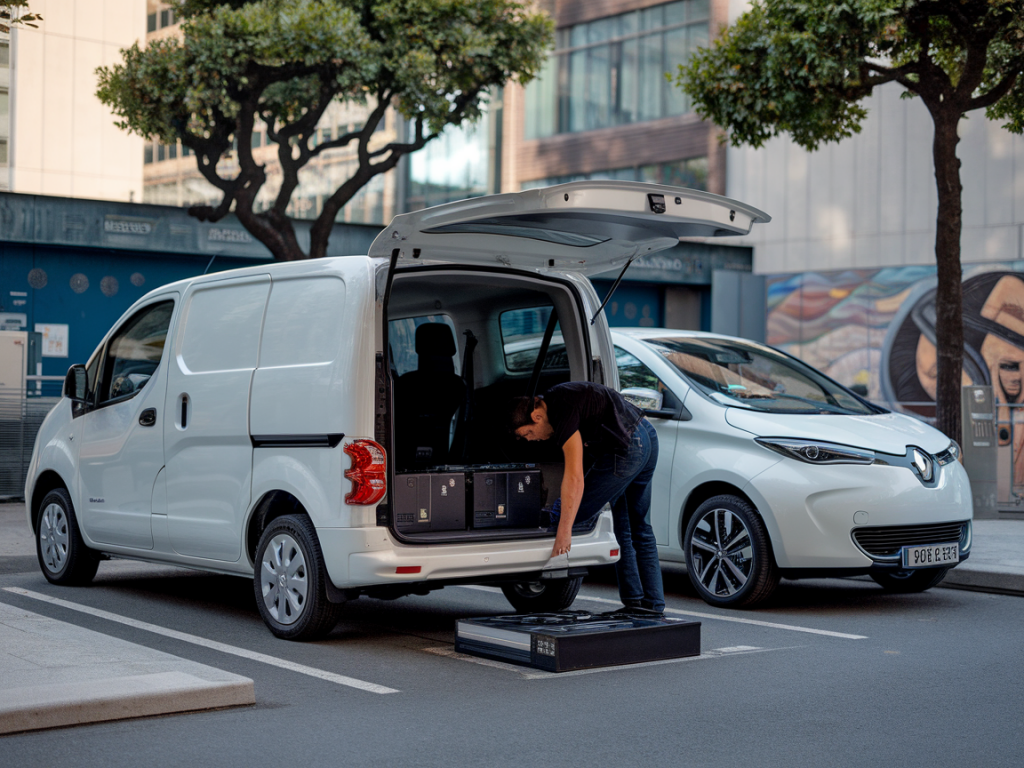
As someone who follows urban mobility closely, I've been watching the rise of electric vans with particular interest — especially models from Nissan and Renault that are already familiar players in the light commercial vehicle space. One question that keeps coming up in conversations with fleet managers and drivers is: can modular battery swaps actually reduce range anxiety for urban delivery fleets? After digging into the technical, operational and commercial angles, I'm convinced the answer is yes — but only if deployed thoughtfully. Here's how I see modular battery swapping working (or stumbling) in real-world city delivery operations.
Why range anxiety matters for urban delivery fleets
Range anxiety isn't just a passenger concern — for delivery fleets, it's a business risk. Missed deliveries, unexpected downtime, and inefficient routing all translate to higher operating costs. Urban fleets using Nissan e-NV200, NV300 electric models, or Renault's Kangoo Z.E. and Master Z.E. face predictable, stop-start urban routes, but also unpredictable peak loads, driver behavior, and shifting traffic patterns. Those variables make rigid battery range a headache.
Modular battery swaps can address that unpredictability by separating vehicle uptime from charging time. Instead of waiting hours for a battery to charge, a vehicle can receive a fresh battery module in minutes and get back on the road — a huge potential win for last-mile operations where time is money.
What I mean by "modular battery swaps"
When I talk about modular swaps I refer to systems where the battery pack is made up of interchangeable modules that can be removed and replaced quickly, either manually or with mechanized assistance. This is different from full battery pack swaps of the past, which were heavy, vehicle-specific undertakings. Modular systems aim to be:
Operational benefits I keep returning to
From a fleet operator’s point of view, modular battery swaps deliver several clear advantages:
Concrete examples with Nissan and Renault e-vans
Nissan's e-NV200 and Renault's Kangoo Z.E. series are ideal testbeds. Their compact platform simplicity makes it feasible to design modular packs that fit into the existing floor or underbody space without radical vehicle redesign. I imagine approaches like:
These configurations would need careful engineering to preserve crash safety, water ingress protection, and thermal management. But for urban fleets that return to central hubs frequently, the depot-based swap works particularly well.
Technology and software: the glue that makes swapping practical
Swapping hardware alone isn't enough. I find the software stack equally critical:
Economics — where the business case gets clear
I've run the numbers with fleet managers, and the key drivers are:
Here's a simplified snapshot to compare traditional DC fast charging vs modular swap in depot operations:
| Metric | DC Fast Charging (depot) | Modular Swap (depot) |
|---|---|---|
| Typical vehicle downtime per refill | 30–60 minutes | 5–10 minutes |
| Infrastructure footprint | Multiple chargers, high power grid load | Swap station, storage capacity for modules |
| Battery lifecycle management | Distributed, variable thermal stress | Centralized, controlled charging |
| CapEx vs OpEx | Lower CapEx (vehicle) / higher OpEx (energy, downtime) | Higher CapEx (swap system) / potential lower OpEx |
Practical challenges I won't gloss over
There are real hurdles to overcome:
How I would pilot a modular swap program
If I were advising a city fleet or a private delivery operator running Nissan or Renault e-vans, I'd recommend a staged pilot:
I've seen pilots in other vehicle segments demonstrate that once the operational workflows are smooth, drivers quickly adapt to swap-based operations — and route planners appreciate the newfound predictability.
Final thoughts (not a conclusion)
Modular battery swaps are not a silver bullet, but they are a powerful tool when tailored to urban delivery use-cases. With Nissan and Renault's e-van families already popular in city logistics, a coordinated effort — involving vehicle design tweaks, depot infrastructure, and interoperable software — could make swapping a practical way to curb range anxiety and boost fleet efficiency. For operators willing to pilot and iterate, the payoff could be significant: more deliveries per shift, lower lifecycle costs, and a smoother transition to electrified urban logistics.